
Book Brew: Tea Dragon Society | Treasury Edition
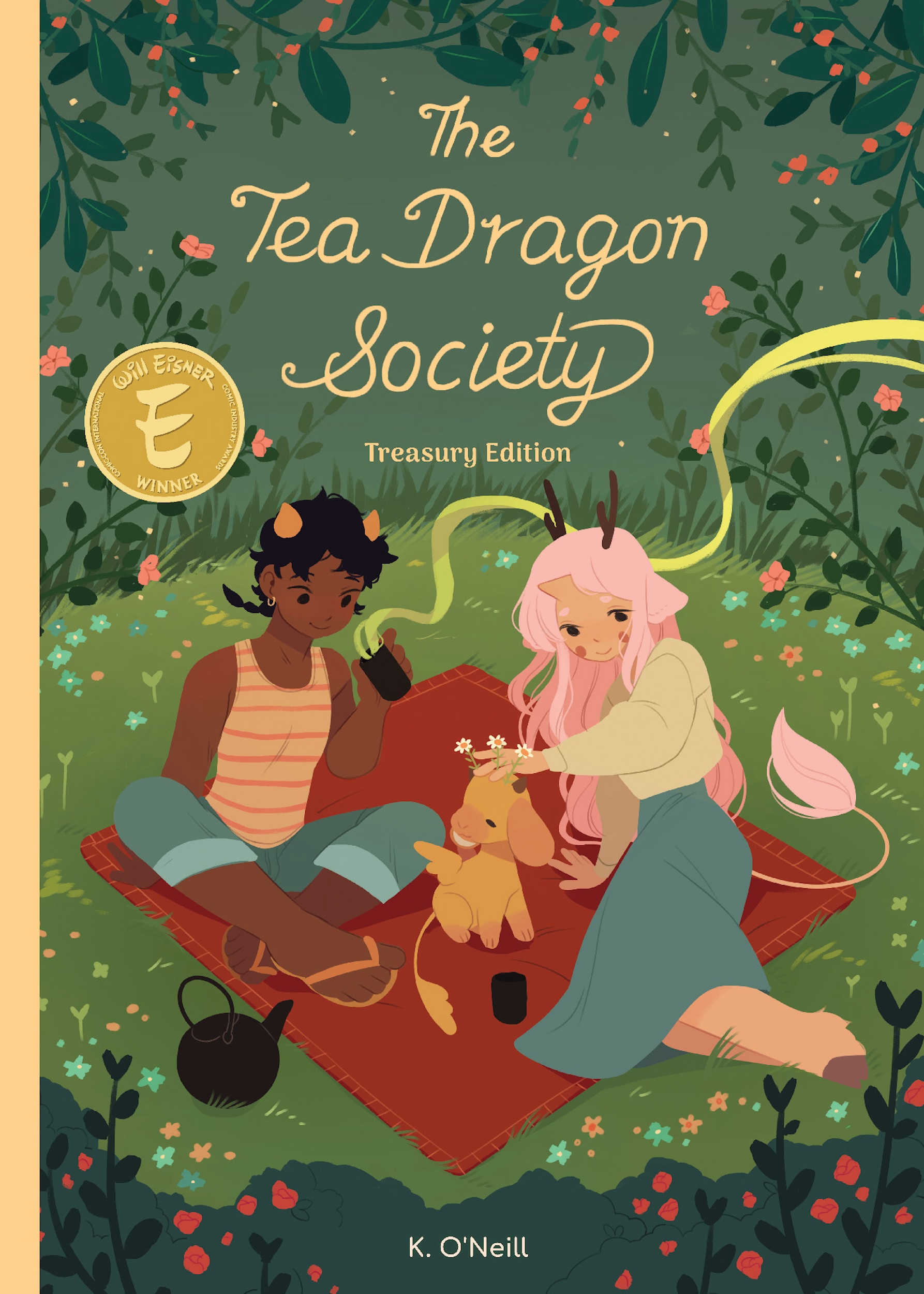
Before I sat down to read this book, I just knew that I had to light a scented candle and put some lofi music on in the background. My environment matched the aesthetic of this book entirely. Well…almost, entirely. I haven’t adopted a tea dragon yet! The world that K. O’Neill (both the author and the illustrator of this book) creates is kind, cozy, and queer. And I am so here for it.
Greta is our POV character, whom we follow throughout nature’s seasons, and her family are blacksmiths. She’s beginning to learn this trade from her mother, whom she clearly respects and admires, but she doesn’t really feel passionately about it in the beginning.
Greta ends up rescuing a tea dragon, instantly forming a trusting bond with it, and returns it to its rightful owner, Hesekiel (Hesé, for short). This guy is such a delight – very calm, gentle, and wise – and gives off maaaaajor Master Splinter vibes from the Teenage Mutant Ninja Turtles franchise. He also reminds me of Rauru from The Legend of Zelda: Tears of the Kingdom video game.


It is through him that Greta learns about the history of tea dragons, meets his partner, Erik, and eventually befriends Minette, a creature-girl with hooves, antlers, a horn, and a very shy disposition; but only at first.
There’s so much about this book that I could praise, so I’m going to start with the effortless crafting of this magical, fantastical world. The manner in which it’s built doesn’t feel forced, solidified by the artwork that K. O’Neill has drawn. Their characters are soft, the environments they inhabit smooth. I appreciate how O’Neill’s art style also supports the fluidity of gender expression, illustrated in the clothing choices, hair styles and length, and the body builds, to name a few.
This is a universe that I very much want to visit, and can I just say that the tea dragons themselves especially are ADORABLE. I want to take care of one of the Rooibus Tea variety. If you know, you know. If you don’t, read this book! (O’Neill includes excerpts from the Tea Dragon Handbook that lists tips on how to care for the tea dragons as well as all profiles of the various kinds of tea dragons out there!)

I can very much see this world being a good diving off point for a video game concept, but you can tell that O’Neill doesn’t necessarily have that goal in mind. They wanted to portray some incredible themes to live life by in a very soft and kind way. For example, there was such wonderful representation all across the board of people of color, people that are differently abled, various body types, and those a part of the LGBTQIA+ community.
Since this is a book whose target audience is children, including people who have different personalities, traits, and backgrounds is essential to a healthy upbringing. I don’t have kids yet, but this would be a wonderful book to share with them as they grow up. I mean, there are just so many topics that are subtly and gently introduced; it’s just wonderful to read. Like when Minette wrote a letter to her parents (whom she can barely remember due to an accident that affected her ability to recollect her past) saying that she is going to discover who she is outside of the monastery, which is where her species of creatures resides. There she is, laying a boundary, realizing that she needs to break out of the box she was put in in order to find out who she truly is, and that she needs to tackle that alone. That is really beautiful to me because it’s evident of such a mature step Minette is taking on her journey of growth. My mom wouldn’t have it, but, then again, this is still a fantasy book! 😂 Still very impressive for a children’s graphic novel.
Anyway, I have to mention how the crush between Greta and Minette was presented, and how O’Neill addressed the concept of generational learning.
Oh my gosh. The purity of a childhood crush is so endearing and beautiful. I don’t know why we lose that honesty, that rawness of (simply) feeling, as we get older; it felt like this was a reminder from O’Neill to really cherish and value that as much as possible: that inner child innocence as you navigate new things and feelings for the first time. It was the purely innocent nature of their relationship that really grounded me.
Finally, O’Neill comments on how knowledge is handed down from generation to generation through teaching and listening. We see this as Greta absorbs the ways of blacksmithing from her mother, and as both Greta and Minette learn about the history of tea dragons from Hesekiel and Erik. The society can only grow from there, as the girls will most definitely educate others after them about the tea dragons. It’s heavily implied that O’Neill values the past and what it has to offer as we learn from it, but also treasures, embraces, and is very grateful for what they have now in the present moment; another valuable piece of advice they managed to sprinkle into this book! They can really do it all!!
Hesekiel says something on page 36 that really struck me…“People seem to live at a different pace, now.” This can be applied even to today’s era. It’s good to try and not lose everything we can gain from the past, but we don’t want to look back so much that we lose sight of where we are right now. Learning how to integrate these two ways of viewing life isn’t easy, but finding that balance is well worth it. How lovely that a work so fantastical was such a great example of how human people can be.
Rating: 4 out of 5
Writer/Artist: K. O’Neill (they/them/theirs)
Publisher: Oni Press Publications (Oni-Lion Forge Publishing Group, LLC.)
Price: $19.99

 Pop Culture Uncovered
You must be logged in to post a comment.