
Weekend Coverage: Sensational She-Hulk #1
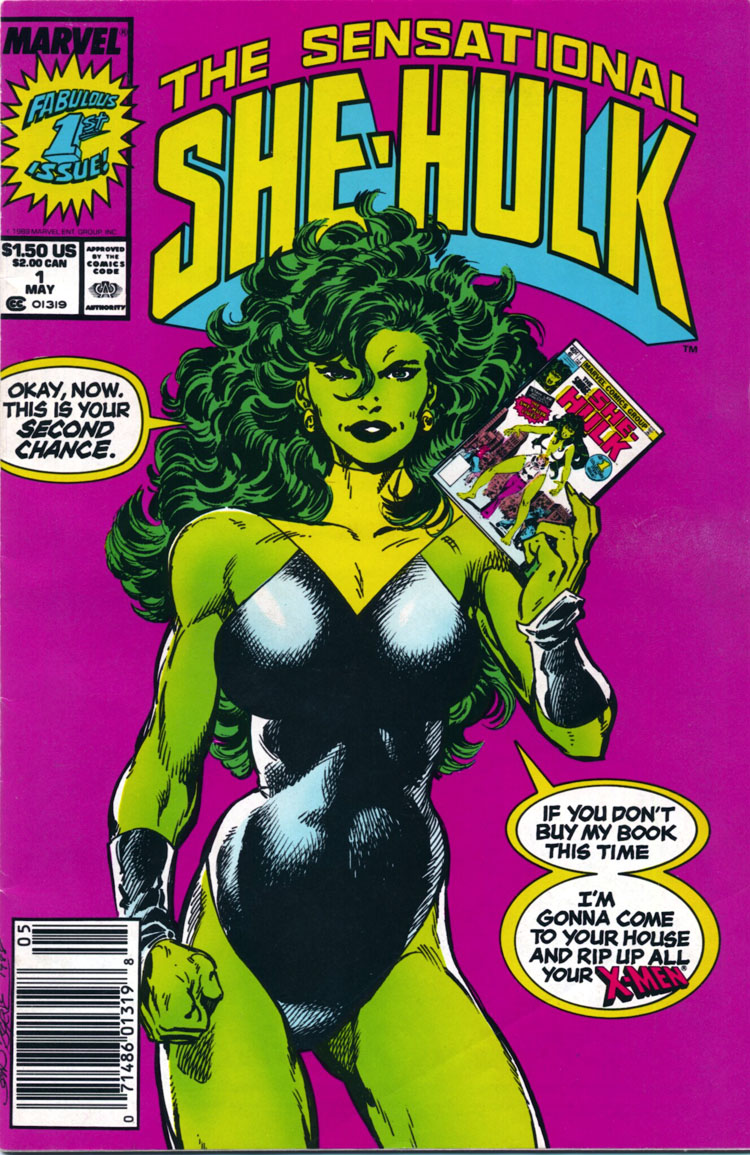
I remember 1989 and Marvel Comics fondly. I was 11 years old. The Hulk was a grey legbreaker in Las Vegas. There were two Avengers teams on opposite sides of the country. The X-Men were big, but not that big. Crossovers tended to be limited to three-month events or summer annuals. And John Byrne seemed to be writing and drawing about a third of Marvel’s books, and was strong enough to convince the company to let him launch a She-Hulk solo title.
Something about this cover caught my eye and made me pick it up. At age 11, my friends and I weren’t really “collectors” yet–we were just kids who wanted to read good superhero stuff. I generally stayed away from “girl” books, and I’m not sure there were many on the market in 1989 outside of Wonder Woman anyway. But something about this cover with a muscular, female version of my favorite superhero called to me and told me to pick it up.
Literally, the cover is talking to the reader, which is what makes Sensational She-Hulk #1 so memorable among Marvel’s classic covers. (Seriously, this cover has been parodied at least three times.) Here’s the She-Hulk, who at the time was a b-rate superheroine, literally talking to you the reader and telling you to buy it because you didn’t support her book the last time she had one. This was a little unusual of a sales pitch. Covers normally give you a hint at what the interior story is going to be, or signal that something dramatic or earth-shattering will happen in the story.
Here, the She-Hulk was threatening you.
This kind of cover was par for what Byrne did with the She-Hulk title. It was an “interactive” book where She-Hulk lived out (ab)normal superheroic adventures, but also directly addressed both the reader and the creator on a regular basis. It played around with the very physics of comic books, with She-Hulk walking between panels in order to quickly move across town, or tearing through a page and running across an advertisement in order to escape a trap. Deadpool comics have been pulling this kind of thing for awhile, but Byrne did it first, and in many ways, I think Byrne did it better.
It’s funny that Byrne doesn’t seem to get along with Grant Morrison, because both authors have used the notion of an interactive comic book to varying degrees. (I’ve found at least one quote from Byrne where he speculates that Morrison doesn’t “get” the comics genre.) Of course, they had different intentions and purposes in doing so. In Morrison’s madness, he’s used books like Seven Soldiers and Multiversity: Ultra Comics to show that our real world and the DC Universe are both actual, living places and that comics are our magical means of viewing each other. Byrne’s intentions aren’t quite so grand: he just wanted the reader to have fun interacting with the book, as if they’re watching a Looney Tunes short.
The simplicity of this cover is great. There’s nothing more to it than She-Hulk and her logo. It’s a fairly typical Byrne drawing of the day (which, frankly, I think looks better than a lot of the penciled work he does now). It also has the fun historical element of Shulkie holding her original solo title from 1980–it’s like she’s holding her own little piece of comic book history right there, a fun detail that you can study on the cover for a moment.
The color contrast of Shulkie’s green against the cover’s purple is great, specifically because there’s no background. This cover doesn’t need one, so it may as well be one solid color. Purple, of course, is a nice, muted contrasting color against her relatively light green skin tone. It draws you directly to the figure and makes it stand out.
If there’s any downside to this cover, it’s She-Hulk’s colossal hair. It’s 1989, so big hair was still pretty common and Shulkie probably looks like any other woman of that era. By today’s standards, I’d say it’s a bit excessive and could stand to be trimmed about 10 percent.
But really, the selling point is the dialogue: buy this comic or lose your X-Men books. It set the tone at the outset that Sensational She-Hulk was going to be a wacky, different kind of superhero comic involving a character who’s just a little bit threatening. I fully expect that somebody is going to parody this cover again someday in the future, because it just works so well as a way of getting our attention.

 Pop Culture Uncovered
You must be logged in to post a comment.