
Thor #1: The Fleeting Age of Freyja Begins Anew

Warning: As with all reviews, this one contains SPOILERS. Actually, lots, for the end of the last Thor series, the Tenth Realm, and Original Sin. So this is the ‘short version’ – here there be minor spoilers only. Keep scrolling for a longer, in-depth breakdown of the book, because I consider it one well-worth discussing.
Jason Aaron, who has written Thor: God of Thunder for the last 25 issues, is a personal favorite of mine for his ability to capture the ‘Norse ambience’ I look for in a title centered on Asgard. Not since Journey into Mystery has there been an author so good at combining an ancient, godly feel with a modern, believable mode of speech. Likewise, he shared Journey into Mystery’s good fortune in combining those talents with an excellent artist, Esad Ribic, who drew Asgard and its denizens as both creatures of myth and flesh, mingling uneasily with the real world, but always carrying a tinge of the fantastic with them.
Sadly, only half the team made it across the ‘new #1’ divide: In Thor #1, Aaron is joined instead by Russell Dauterman and Matthew Wilson for the art and color, and the book suffers for it. The art is realistic enough, dynamic enough, and interesting, with some fascinating use of ‘coloring outside the lines’ to add dimension behind, around, and occasionally in front of the panels, but the mystical ‘Asgardian’ feel is somewhat lost, making the undersea battles feel like they could just as well be happening in New Avengers or the X-Men.
That said, the writing continues to sparkle in this new, interesting twist in the God of Thunder’s life, and what we are left with is essentially a set-up issue, with Odin and Freyja jostling for political supremacy, Thor facing life without his hammer, and a single, dramatic page declaring the masculine hierarchy of Asgard will be facing some serious challenges in the future. It appears that the female Thor, rather than being a simple device to change up the plot, or a temporary fill-in for the real deal, is here to make a statement.
I highly recommend following this series to see what that statement turns out to be. For more on the issue itself, and its implications, read on below:
The ‘No really, there are lots of SPOILERS here’ cut
Make no mistake; for all the hype, the rumors, the poignant images of Thor despairing on the moon, and the publicity shots of a mysterious, hammer-wielding woman: Marvel’s Avengers Now! Thor #1 (and a pox on the Marvel naming system for making me type that ludicrous way of differentiating reboots) is about Freyja.
With the conclusion of Original Sin: The Tenth Realm, Odin returned to the Marvel universe from his seclusion on Old Asgard, as suddenly as he disappeared a few years back. But let not his profoundly touching words to Thor and Loki as that title concluded confuse you: this is the All-Father of old, and years of chess have not given him greater patience or a more modern outlook on life. Original Sin itself ended with Thor stuck on the moon, unable to fly, or even lift his hammer. Thor #1 returns to that scene, as the warrior struggles for weeks to lift the hammer, pleading with his beloved hammer to find him worthy.
It is here, as Odin displays his classic tact, demanding to know what foolishness rendered Thor unworthy of the hammer, then accusing Freyja of coddling him, and her reign of weakening Asgard, that Jason Aaron begins to toy with the classic format of the Asguardian system. The All-Mother stands unimpressed at the accusation. She need not lift a finger to defend herself; every warrior of Asgard has tried and failed to lift the hammer, and they do not hesitate to suggest that the fault lies in the spell Odin placed upon it.

When Odin goes to collect the ‘broken’ weapon and is unable to lift it, he is consumed by wrath, threatening the hunk of stone with dire fate. Freyja, always the diplomat and politician, simply declares that it is unwise to let weapons choose those worthy to wield them, and turns her attention to talking Asgard’s greatest warrior into getting out of the fetal position and into a fighting stance.
It is apparent that Aaron does not intend to remove the Thunder God from the book entirely, a wise choice to appease those resistant to continuity changes; he is no less the God of Thunder, simply one returned to the state of Young Thor from Aaron’s earlier run, riding flying chariots pulled by goats and smiting threats with a giant axe.
But, again, the focus of the book is not on the dramatic fight scenes; it is on simple panels of Odin and Freyja. With a threat to Midgard arising, the warriors as their liege for guidance, and receive unhesitating, contradictory orders from both. In the face of Odin’s challenge, Freyja is unyielding. The All-Father may have returned, but in her eyes, this changes nothing, while to him it is unthinkable that it does not transfer power back to himself.

With Midgard threatened and Thor unsteadily back on his feet, Freyja wins the debate by default; the Thunder God is off for a dramatic battle with the increasingly ever-present Maleketh (curse you, characters only popular because of the films!). Odin will not permit her to depart, however, without a terse reminder to remember her place; ‘the fleeting age of the All-Mother is over…with Odin alone above all’.
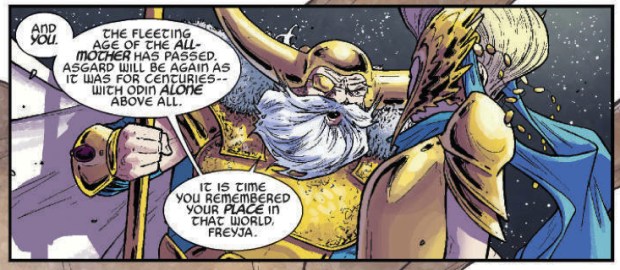

Freyja, it would seem, is very aware of her place; as in the second Thor film, she shows a hint of where Loki learned his deviousness. She does not try to challenge him again politically, at least not in this issue. She does not cease to be concerned for her son, but continues to see him as he wishes to be seen; a powerful warrior she can not order to eat or rest.
She does not try to lift the hammer. Unlike Odin, the All-Mother is under no illusions that power and worthiness go hand in hand. But she does not surrender either.
It is not apparent where the new, female Thor comes from; some have suggested she was made of Thor’s severed arm, others believe she is one of the three granddaughters glimpsed occasionally in the fantastic earlier Thor titles by Aaron. What is apparent is that she is a device of Freyja’s, a challenge to the all-male hierarchy of Asgard.
This masculine hierarchy is stressed throughout the book; the Lady Sif is not seen among the moon’s warriors, and rather than appear dressed for battle as she does in Journey into Mystery or Loki: Agent of Asgard, the All-Mother is dressed in a gown, regal, non-combative garb. Freyja and Odin have battled throughout the recent history of Marvel titles, disagreeing on key points, particularly their children (one wonders how Odin will feel about her decision to keep Old Loki in the basement, not to mention letting a disillusioned Young Loki wander around Manhattan picking accidental fights with Doctor Doom). But Aaron seems to be setting them on a collision course, one with the All-Father’s might and ancient knowledge set against a new, modernized Asgard with years of Midgardian experiences and hard-earned respect for their queen, not to mention a new, decidedly feminine Thor, manifestly deemed worthy in ways he himself was not.
Wherever the Thor series goes from here, there are clearly fireworks ahead, from the halls of state to the seas of Midgard; I for one can not wait to see what comes next.
Love the new take on Thor #1, or hate it? Leave your comments below!

 Pop Culture Uncovered
Frejya, Freya’s daughter, someone Freyja created….she has something to do with this new chick. I know it!
LikeLike